Introduction: 10 Minutes of Peace in a Busy Life
Every day, facing the pace of work, family, and social life, both body and mind tend to feel tense. The simple qigong in traditional practices is a gentle way designed for modern people. No equipment is needed, no need to go out, just 10 minutes every day can help you release accumulated stress and bring your body and mind back to balance. This set of movements is simple and safe, suitable for all age groups, especially those who sit for long periods, have stiff shoulders and necks, or suffer from poor sleep.
Why Choose Simple Qigong?
The core of qigong lies in "seeking stillness in movement and nurturing energy in stillness." Unlike intense exercise, it gradually unblocks the body's energy channels—referred to in traditional Chinese medicine as "qi and blood" —through slow movements combined with deep breathing. When qi and blood flow smoothly, stiff parts of the body naturally relax, and emotions also stabilize. A 10-minute daily practice is like a gentle "internal massage" for your body.
Common discomforts it helps with:
- Shoulder and neck pain, stiff back
- High work pressure, prone to anxiety
- Light sleep, difficulty falling asleep
- Lack of energy, easy fatigue
Technique Explanation: A Relaxation Technique - "Rising and Falling, Opening and Closing"
Today we introduce a very classic basic movement - "Rising and Falling, Opening and Closing." It combines four steps: rising, lowering, opening arms, and joining palms, and is combined with breathing to quickly relax the upper body, especially the shoulders and intercostal muscles.
Movement Steps:
- Preparation Posture: Stand with feet shoulder-width apart, knees slightly bent, hands naturally hanging by the sides of the body. Close your eyes, take three deep breaths, feeling the air slowly flowing into your abdomen through your nose.
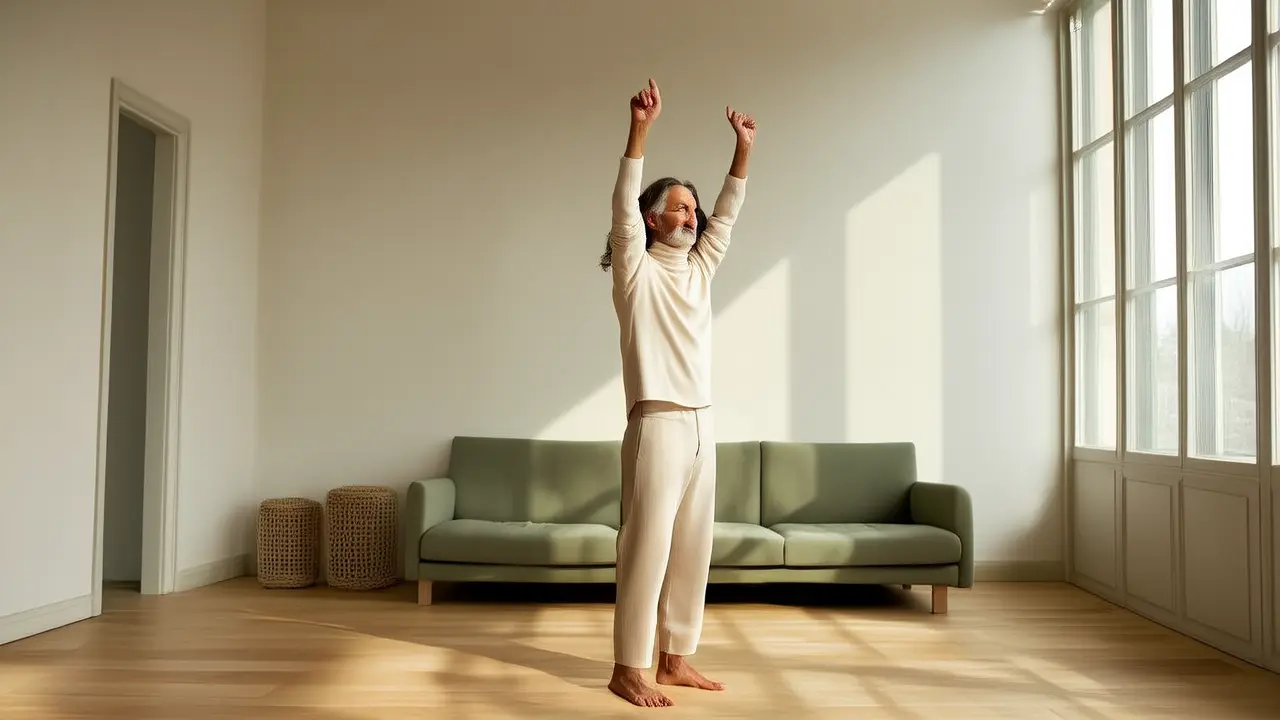
- Inhale and Raise: As you inhale, slowly raise your hands from both sides, palms up, until they are above your head. At this moment, squeeze your shoulder blades together, and slightly expand your chest. Hold for 2 seconds.
- Exhale and Lower: Slowly exhale, and lower your hands from the front of your head, palms down, passing by your face and chest, finally returning to the front of your lower abdomen, with your hands overlapping (men place the left hand inside, women the right hand inside). Imagine expelling all the waste gas of the day.
- Opening and Closing to Expand the Chest: Inhale, and spread your hands to both sides, palms forward, until they are at shoulder width, feeling your chest stretch forward. Exhale, slowly bring your hands back to your chest, palms facing each other, as if embracing a balloon. Repeat 3 times.
Points for Breathing Coordination:
Breathe through your nose throughout. When inhaling, feel your abdomen slightly rise; when exhaling, your abdomen naturally sinks. The movements must be slow, even slower than your usual walking pace. If you feel dizzy, it means your breathing is too fast or your movements are too vigorous. You can slow down or reduce the number of repetitions.
Mild Adjustment Principle: Unblocking Qi and Blood, Using Stillness to Control Movement
From the perspective of traditional Chinese medicine, stress is closely related to "qi stagnation" in the body. When people remain in a tense state for a long time, the qi mechanism becomes blocked in the chest and shoulders, leading to shallow breathing and stiff muscles. This "Rising and Falling, Opening and Closing" movement opens the chest cavity through arm movements, combined with deep breathing, directly affecting the "膻中穴" (the middle point between the two nipples), which is known as the "sea of qi" in the human body, helping the qi mechanism flow smoothly. At the same time, the slow movements bring attention back to physical sensations from chaotic thoughts, achieving a state of "unity between body and mind" for relaxation.
Consistently practicing for 10 minutes every day is equivalent to establishing a "stress relief switch" for your body. There is no need to pursue perfection; as long as you feel comfortable and not strained, it's sufficient.
Summary: Bringing Calm into Daily Life
The greatest charm of simple qigong lies in its "ease of practice." You can practice it after waking up in the morning, during a lunch break, or before bedtime. The time cost of 10 minutes is almost zero, yet the sense of relaxation it brings can last the whole day. Try not to rush for quick results, but focus on the connection between each breath and movement. Gradually, you will find that your shoulders are no longer so heavy, and your sleep quality quietly improves. Remember, this is a way to communicate with yourself, not a task.
Finally, a reminder: This article is for sharing health knowledge only and does not provide medical diagnosis or treatment plans. If you have severe physical pain or psychological distress, please consult a professional doctor or therapist.