Regain a Good Night's Sleep from Ancient Wisdom
Modern life is fast-paced and stressful, and many people face difficulties falling asleep and experiencing shallow sleep. In fact, thousands of years ago, ancient Chinese people developed a gentle "exercise therapy" - Qigong. It requires no equipment, nor does it pursue heavy sweating; it simply uses simple movements combined with deep breathing to gradually relax tense bodies and calm anxious minds. Today, we introduce an extremely simple Qigong method - "Standing Post Breathing Regulation." Spend 10 minutes before bedtime practicing daily, which helps to unblock the flow of qi and blood, relax the body and mind, thus naturally improving sleep quality.
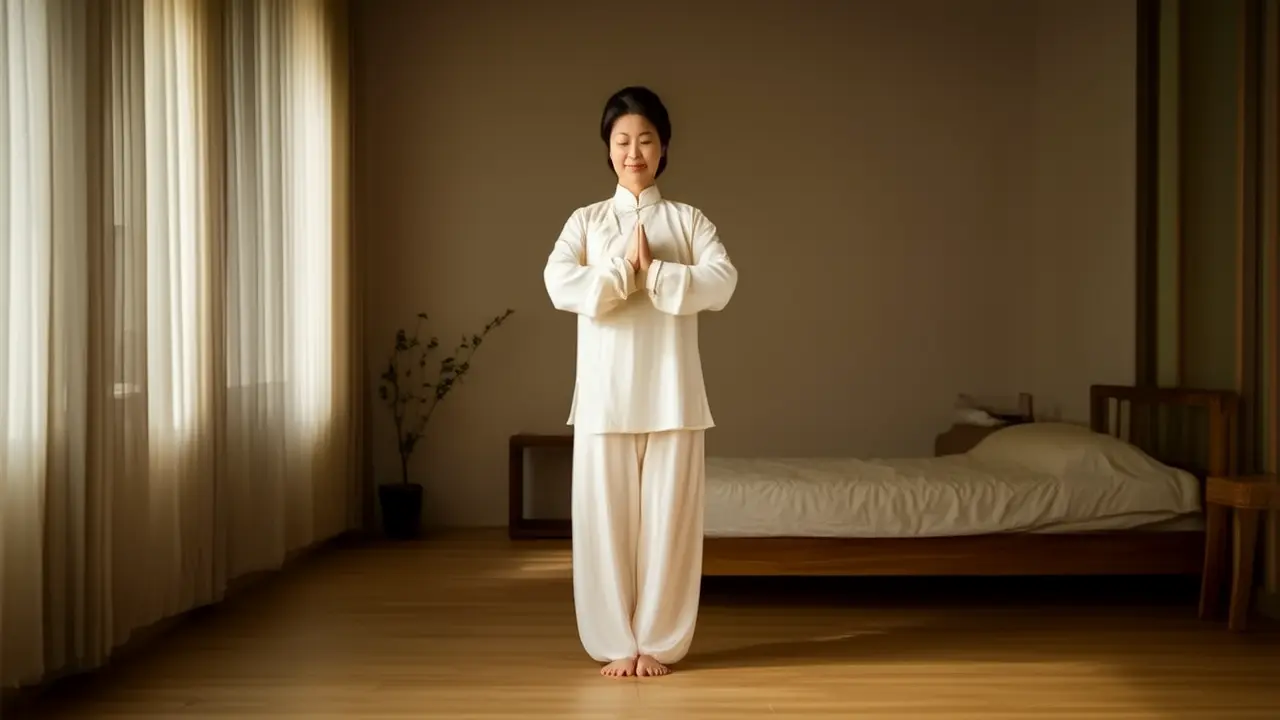
What is "Standing Post Breathing Regulation"?
"Standing post" is the most basic posture in Qigong. It may seem like just standing still, but internal qi and blood are quietly flowing. It is especially suitable for:
- People who sit for long periods during the day and have stiff backs and waist
- Friends who have restless thoughts at night and have trouble falling asleep
- Older adults with weak constitutions who cannot engage in intense exercise
Four Simple Steps of the Exercise
Step 1: Preparatory Posture (1 minute)
Stand with your feet shoulder-width apart, knees slightly bent, not locked. Let your hands hang naturally by your sides, tuck your chin slightly, and gently close or half-close your eyes. Feel like a tree, firmly rooted on the ground.
Step 2: Relaxing the Waist and Sinking the Pelvis (2 minutes)
Imagine there is an invisible chair under your buttocks, and you gently sit on it. Relax your waist, don't stand too straight. Keep the natural curve of your spine. At this moment, you will feel the entire body's weight sinking to your feet, and your knees and hip joints get a slight stretch.
Step 3: Embracing a Ball Hands (3 minutes)
Slowly raise your hands to chest level, palms facing each other, about the width of a fist apart. Fingers slightly curved, as if embracing a balloon. Arms form a circle, elbows naturally drooping. Maintain this posture, shoulders must be relaxed, do not hunch them.
Step 4: Deep Breathing Regulation (4 minutes)
Keep the "embrace a ball" posture and start abdominal breathing:
- Inhale: Breathe in slowly through your nose, letting your abdomen expand like a balloon, feeling the breath filling your chest from bottom to top.
- Exhale: Breathe out gently through your mouth (or nose), allowing your abdomen to slowly contract, feeling the release of stale air inside your body.
Note: Breathing should be deep, long, even, and slow. Try to extend each inhalation and exhalation to 5-6 seconds. You can silently count in your mind, or imagine the breath flowing like warm water throughout your body.
Mild Adjustment Principle: Unblocking Qi and Blood Flow, Balancing Movement and Stillness
From the perspective of traditional Chinese medicine, "Standing Post Breathing Regulation" integrates the concept of "seeking movement within stillness." Although it appears still, muscles, meridians, and qi and blood inside the body are working gently:
- Slightly bending the legs can stimulate the foot three yin and three yang meridians, promoting circulation in the lower limbs and relieving stiffness caused by prolonged sitting.
- The "embracing a ball" posture stretches the heart and pericardium meridians on the inner side of the arms, helping to calm the mind.
- Abdominal breathing directly massages the abdominal organs, regulating the autonomic nervous system, balancing the sympathetic and parasympathetic nerves, allowing the body to switch from "fight mode" to "relax mode."
Consistently practicing it before bedtime every day, you will find that your breathing becomes deeper, your mood calmer, and falling asleep is no longer "restless," but easier to enter deep sleep.
Simple Persistence, Naturally Sound Sleep
Standing Post Breathing Regulation does not require a specific place; you can do it on the bed or floor wearing loose pajamas. The key lies in "natural, relaxed, and persistent." If your legs ache after standing for a while, you can gently shake your legs to adjust, without forcing yourself. Practice for 10 minutes every night before going to bed, and after some time, you may be pleasantly surprised to find: sleepiness comes faster, dreams are fewer, and you wake up more refreshed. This is the gentle gift of ancient exercise therapy to modern people.
Disclaimer
The exercise methods introduced in this article are for personal health reference only and do not constitute medical diagnosis or treatment advice. If you suffer from severe insomnia, cardiovascular disease, or other health issues, please consult a professional doctor first. If you feel uncomfortable during practice, stop immediately and rest. This platform does not assume any responsibility for health problems arising from the use of the content in this article.