Introduction: Finding Peace in the Rhythm of Breath
In today's fast-paced life, many people often feel stiff shoulders and necks, and tense emotions, yet lack the time or conditions to go to a gym. Actually, the ancient Eastern health wisdom - Qigong - does not require complex equipment or years of practice. Today, we start from scratch and introduce three simple and gentle movements. They can be done at home, in the office, or on park benches, requiring no equipment at all. Just by coordinating with deep and long breathing, they can help unblock the flow of qi and blood, relax your body and mind, and bring back that long-lost sense of comfort.
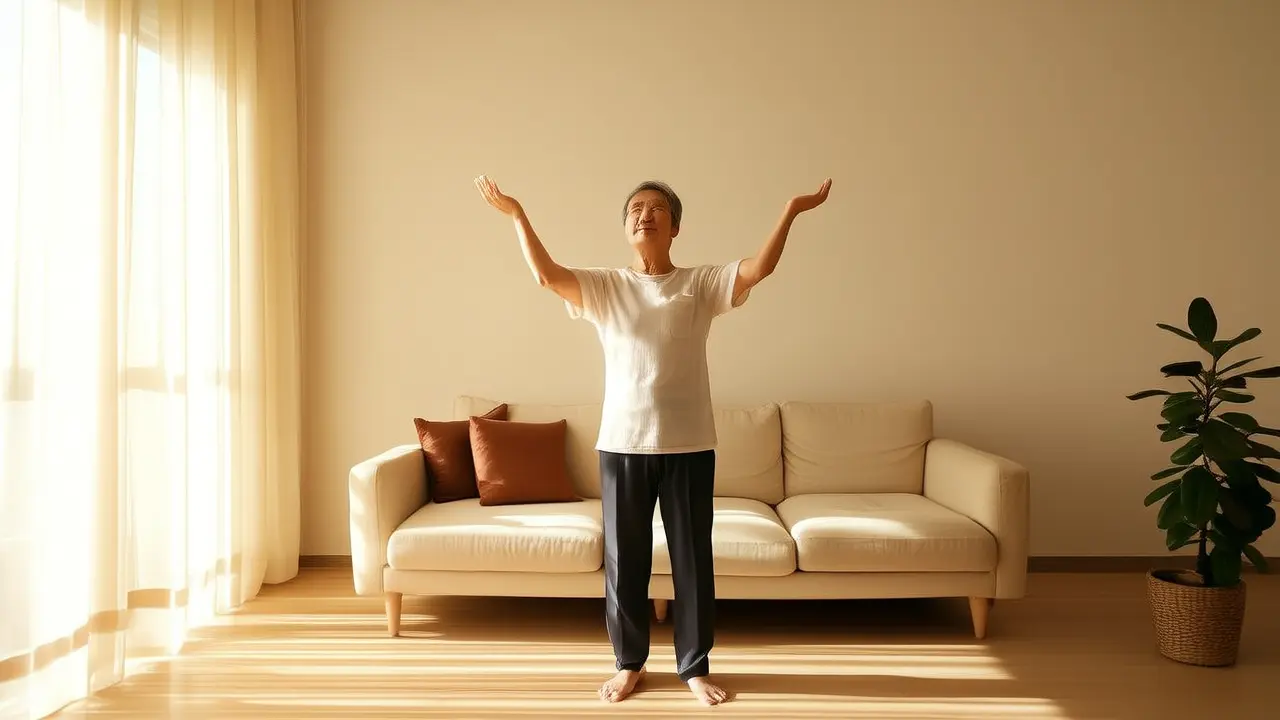
Exercise 1: Hands Holding the Sky to Regulate the Three Jiao - Stretching the Upper Body
Applicable situations: Shoulder and neck pain, chest tightness, feeling like "a bundle" after sitting for a long time.
Steps: Stand naturally with feet shoulder-width apart. Cross your hands in front of your abdomen, palms up (men have the left hand inside, women have the right hand inside, or it can be arbitrary). Inhale, slowly raise your hands as if holding a light cloud until above your head, palms up, eyes looking straight ahead. Hold this position, hold your breath for 2-3 seconds, feeling the entire spine being stretched. Exhale, slowly lower your hands back to the front of your abdomen. Repeat 6-8 times.
Respiration Coordination: Inhale while lifting, hold breath while staying still, exhale while lowering. The breathing should be deep, slow, even, and long.
Gentle Adjustment Principle: This exercise originates from the Eight Brocades. By raising and lowering the arms, it promotes the circulation of qi along the Sanjiao meridian. It can relieve stiffness in the scapulae, gently stretch the underarm lymph, help breathe more deeply, and thus calm anxiety.
Exercise 2: Like a Bow Shooting a Crane - Activating the Spine and Sides
Applicable situations: Tight back and waist, soreness on both sides of the ribs, feeling like an iron rod after sitting for a long time.
Steps: Take a large step apart, squat into a horse stance (if knee discomfort occurs, slightly bend the knees). Cross your hands in front of your chest, make a fist with the left hand and push forward, while pulling the right hand backward, as if drawing a bow. Look in the direction of the index finger of the left hand. Hold for 3-5 deep breaths. Then switch sides, push the right hand forward and pull the left hand back. Do each side 3 times.
Respiration Coordination: Inhale when pushing forward, hold breath when drawing the bow, exhale when switching sides.
Gentle Adjustment Principle: This movement twists and bends the spine, stimulating the Dai Mai and Bladder Meridians—these are the largest detoxification channels in the body. With the breath held, the qi will flush out tense muscles, gradually softening the sides of the waist and back. Although the movement is simple, it brings a sensation similar to wringing out a towel.
Exercise 3: Cradle Relaxation - Giving the Whole Body a "Massage"
Applicable situations: Feeling completely "stiff," irritability, or heavy legs after standing or sitting for a long time.
Steps: Lie on your back on a yoga mat or firm bed, bend your knees, and use your hands to hold the lower part of your calves, pulling your knees toward your chest. Gently roll your spine forward and backward, like a cradle, from the tailbone to the shoulder blades, then back again. The range should not be too large, just comfortable. Roll continuously 10-20 times.
Respiration Coordination: Exhale when rolling forward, inhale when rolling backward. Keep natural breathing without holding your breath.
Gentle Adjustment Principle: The cradle pose is a classic relaxation method in traditional Chinese medicine. It uses the weight of the body to massage the nerves and acupoints on both sides of the spine, directly relaxing the erector spinae muscles in the back. At the same time, the curling action can soothe the parasympathetic nervous system, sending signals of "safety and relaxation" to the brain. It is especially suitable for practicing before bedtime to improve sleep quality.
Summary: Light Daily Care Lies in Persistence
These three exercises take only ten minutes in total, yet they can activate the flow of qi and blood throughout the body. The core of Qigong is not about how skilled you are, but rather finding stillness in movement and gaining relief in stillness. You don't need any prior experience, and you can even do them while wearing pajamas. Set a fixed time each day (such as morning or before bedtime), coordinate with deep nasal inhalation and oral exhalation, and feel your body gradually warming up and becoming lighter. Remember: the movements don't need to be perfect; comfort is the standard. When the body and mind are aligned, comfort will naturally come.
Disclaimer: The content of this article is for sharing health knowledge only and cannot replace professional medical advice. If you have serious diseases or acute pain, please consult a doctor before practicing. If you experience any discomfort during practice, stop immediately.